Founder LaunchliveBy the founder of GOZORA.
GOZORA Verified Outcome
GOZORA Brain
AI-Powered Knowledge Operating System
"Capture Once. Remember Forever. Retrieve Instantly."
GOZORA is a personal, AI-powered knowledge operating system designed to eliminate information overload. It serves as a unified second brain that captures, synthesizes, and retrieves anything you consume.
Core Capabilities
- Universal Ingestion: Send the bot any type of content—YouTube links, GitHub repos, web articles, PDFs, documents, voice notes, or text scribbles.
- AI Curation & Synthesis: The background processing engine analyzes, structures, and scores incoming content into enriched "Knowledge Objects"—generating high-quality summaries, tagging topics, extracting action items, and evaluating signal-to-noise ratios.
- Intelligent Editorial Delivery: Generates curated daily and weekly editions featuring editorial takes, "Build/Learn This Today" guides, open-source picks, and opportunity radars.
- Instant Retrieval: Find exactly what you need instantly via hybrid and semantic natural language search.
System Viewport Preview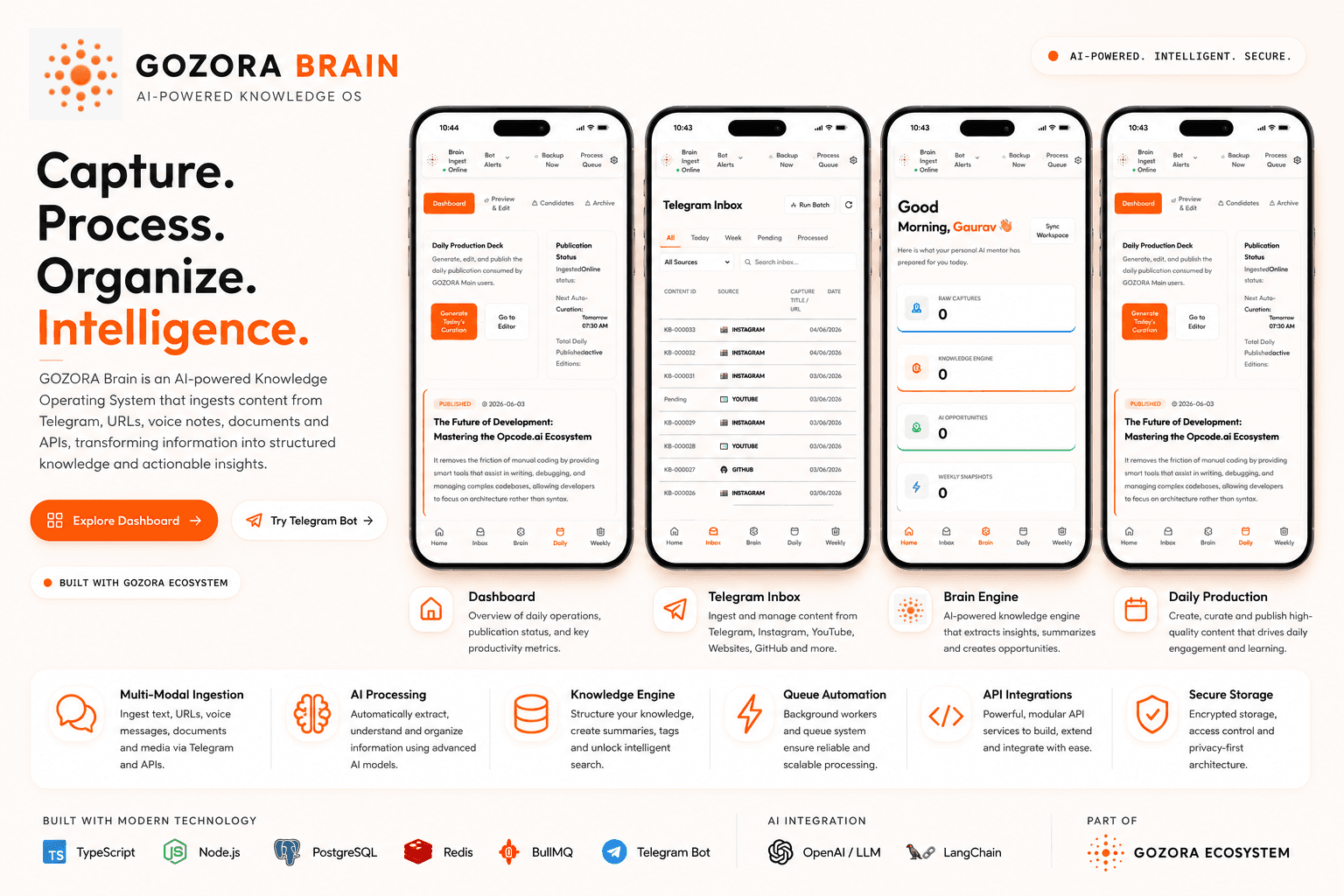
https://gozora.me/daily
The Challenge
GOZORA: Scalable Knowledge Engine
Key Challenges
- Frictionless Ingestion:
- Synchronous Webhook Limits: Handle 30-minute media processing without timeouts
- Network & Rate Limits: Manage rate limits for third-party media downloads and parsing
- Multi-Modal Content Extraction & Scraping:
- YouTube Processing: Extract subtitles, timestamps, and metadata without triggering bot-detection blocks
- Web Scraping: Extract clean main-text content from modern SPAs while discarding ads and navigation menus
- High-Quality AI Synthesis & Curation:
- JSON Schema Enforcement: Extract complex nested data structures from LLM without parser errors
- Editorial Signal Scoring: Develop a consistent scoring algorithm (1–100) to measure signal-to-noise ratio and significance
Technical Solutions
- Graph-Based Concept Mapping (Semantic Links):
- Entity Resolution: Identify and link new captures to existing concepts
- Relationship Extraction: Automate connection discovery between different files, links, or concepts
- Dual-Engine Hybrid Search:
- Keyword Search (Lexical): Find exact phrases, URLs, or specific names
- Semantic Search (Vector): Match abstract concepts and conceptual intent
- Unified Ranking: Combine lexical and semantic similarity ranking for highly relevant results
The Solution
Decoupled Multi-Agent Ingestion Pipeline
- Event-driven ingestion: resolves ingestion bottlenecks and fragmentation through a scalable, asynchronous pipeline.