Join the batch now to learn, build, and grow!
Real AI Implementations.
Measurable Outcomes.
We believe trust is built on verifiable results. Explore live client automations, student capstone engines, and founder MVPs deployed in production.
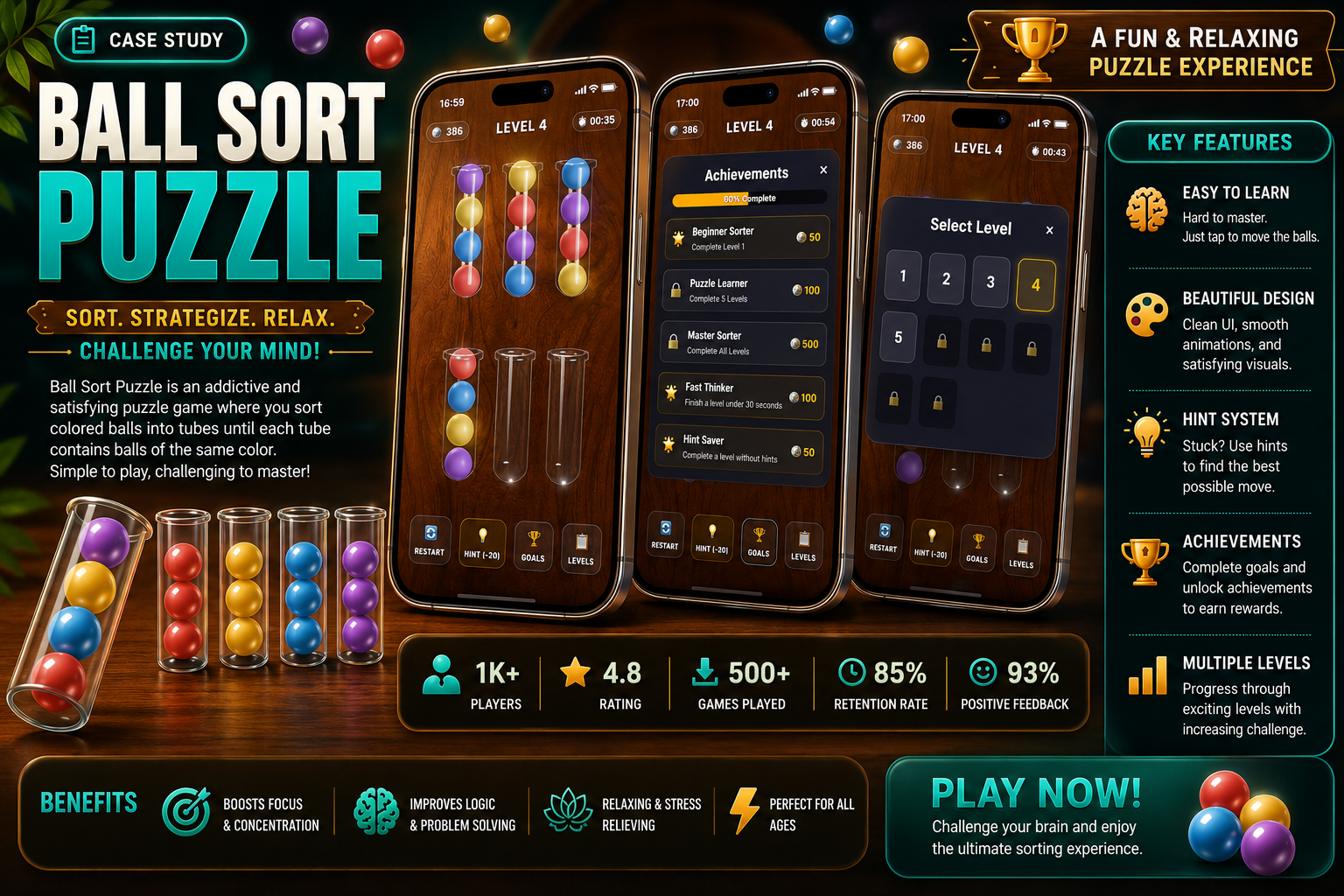
Ball Sort Puzzle
Ball Sort Puzzle is a fun and engaging browser-based puzzle game where players sort colored balls into matching tubes using logic and strategic thinking. With progressive difficulty levels, achievements, hints, and responsive gameplay, the game delivers a relaxing yet challenging experience across desktop and mobile devices.
Building Ball Sort Puzzle required designing an intuitive puzzle system that remains engaging as difficulty increases. The project involved implementing ball-sorting mechanics, level progression, achievement tracking, hint systems, score management, and responsive gameplay while ensuring smooth performance and an enjoyable user experience across desktop and mobile devices.
Ball Sort Puzzle provides a browser-based puzzle experience where players sort colored balls into matching tubes using logic and strategy. The platform automates game rules, level progression, achievements, hint systems, score tracking, and win detection while delivering a responsive and engaging experience across desktop and mobile devices without requiring installation.
* Successfully developed a fully playable browser-based puzzle game. * Implemented color-sorting mechanics, level progression, and win-condition detection. * Added achievements, hint systems, score tracking, and undo functionality to enhance gameplay. * Delivered a responsive experience across desktop, tablet, and mobile devices. * Created an engaging puzzle experience that encourages logical thinking and problem-solving. * Demonstrated practical skills in frontend development, game logic implementation, and user experience design. * Deployed the application online for seamless access without installation.
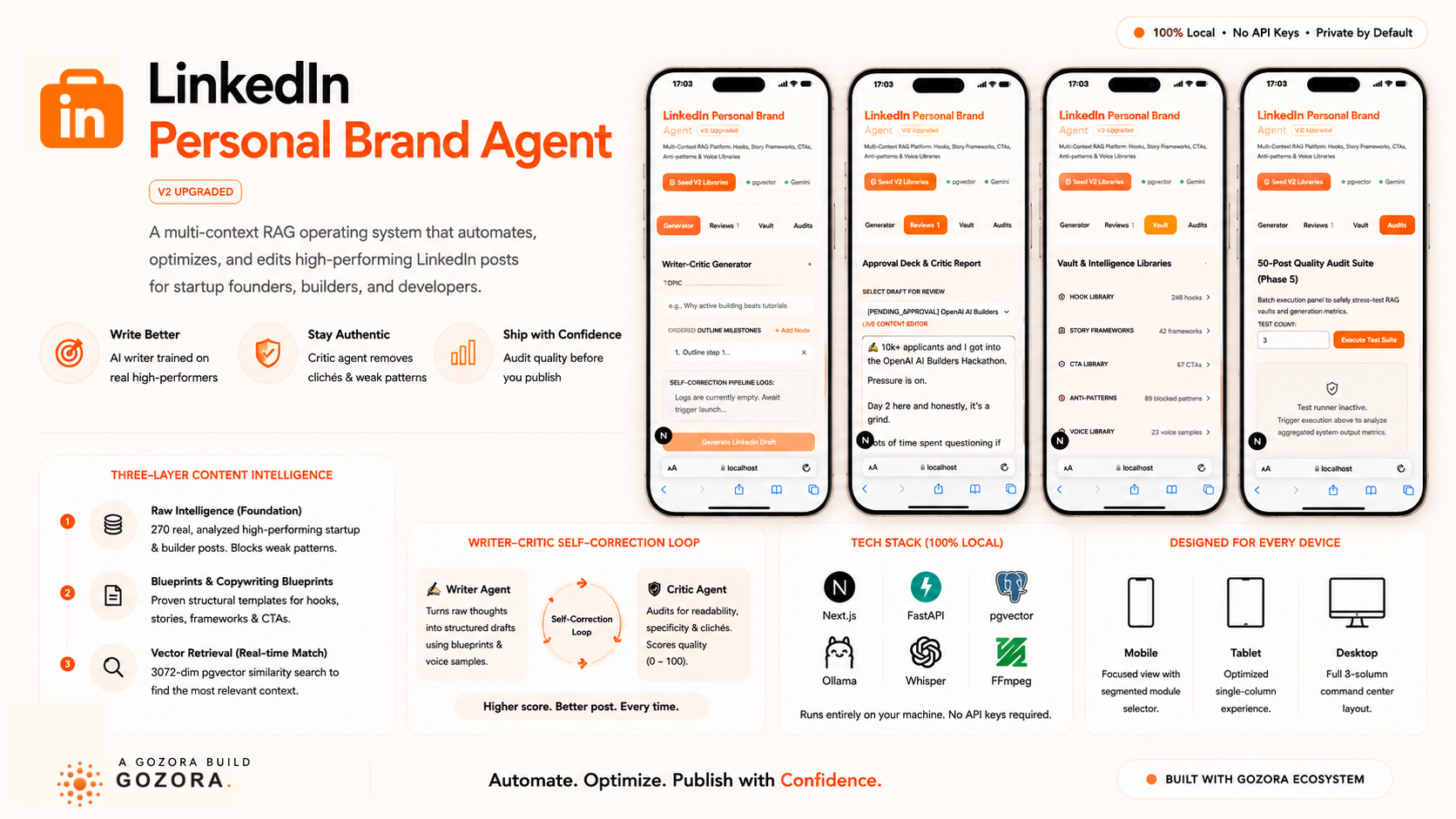
LinkedIn Personal Brand Agent
A premium Multi-Context RAG Operating System that turns raw developer logs and startup convictions into high-performing, mobile-optimized LinkedIn posts. Powered by a 3072-dimensional pgvector similarity vault and a self-correcting Writer-Critic loop, it eliminates generic AI clichés to generate authentic, high-converting content designed to scale personal brands.
Building an authentic, high-leverage personal brand on LinkedIn is one of the most effective strategies for modern startup founders, technical builders, and solopreneurs to drive hiring, distribution, and fundraising. However, they face a severe trilemma: Time, Authenticity, and Technical Specificity. ### 1. The Time Constraint vs. Growth Bottleneck Consistently publishing high-quality content requires hours of reflection, drafting, and editing every week. For founders operating in high-stress, execution-heavy environments, this operational overhead is unsustainable. They are forced to choose between building their product or building their audience. ### 2. The Failure of Generic AI Copywriting Standard AI writing assistants rely on generic prompts and flat training models. This results in content characterized by: * **The "AI Voice"**: Immediate giveaways like *"delve"*, *"leverage"*, *"tapestry"*, and *"in today's digital landscape"*. * **Low Specificity**: Vague, high-level platitudes instead of concrete details (e.g., naming specific file paths, console errors, framework versions, or university classes). * **Audience Disengagement**: Sophisticated tech audiences instantly tune out generic advice, leading to a loss of trust and drop-off in organic reach. ### 3. Context Fragmentation and RAG Limitations Traditional RAG (Retrieval-Augmented Generation) systems draw from flat databases. They fail to orchestrate multi-vault queries, leaving the LLM unable to synthesize: * The user’s raw memory logs (lived experiences). * The user’s core convictions (thought leadership opinion). * Structured copywriting blueprints (proven hook and CTA templates). * Comparative feedback (explicit success and failure references to guide the style). ### 4. The Mobile Operations Friction Founders and builders work on the move. When inspiration strikes or drafts need approval, they use their phones. Standard developer interfaces and multi-column dashboards break down on small viewports, forcing users to scroll through endless sections of input fields, raw JSON reports, and editor textareas. Creating a tool that is highly functional yet visually uncluttered on mobile was a primary user experience challenge.
To solve the authenticity and specificity trade-off, we engineered the LinkedIn Personal Brand Agent—a Next.js and Supabase-powered platform featuring a Three-Layer RAG Architecture and an iterative Writer-Critic Self-Correction Loop. ```mermaid graph TD A[Raw Developer Note] --> B[Auto-Structure RAG Pipeline] B --> C[(Layer 1: Raw Post Intelligence)] B --> D[(Layer 2: Blueprint Libraries)] C & D --> E[Parallel Vector Query RPCs] E --> F[Writer Agent: Draft Generation] F --> G[Critic Agent: Editorial Audit] G -- "Fails Score < 85 or Cliches Found" --> H[Self-Correction Loop + Feedback] H --> F G -- "Passes" --> I[Approval Deck & Publish Queue] ``` ### 1. The Three-Layer Content Intelligence Rather than sending flat prompts to the LLM, the system dynamically curates a highly specific prompt context by querying distinct database vaults: * **Layer 1: Raw Post Intelligence (`raw_post_intelligence`)**: An append-only database housing unedited, high-performing posts. The generation engine retrieves Success Cases (posts with hook strengths >= 8) to mimic positive structures and Failure Cases (posts with low specificity or high cliché density) to explicitly avoid. * **Layer 2: Copywriting Blueprint Libraries**: Four separate libraries storing compiled, deduplicated templates: * **Hooks Library**: Structures proven to hook attention under 140 characters. * **Story Frameworks**: Narrative blueprints (e.g., Problem $\rightarrow$ Attempt $\rightarrow$ Failure $\rightarrow$ Lesson). * **CTA Library**: Direct, context-driven audience engagement prompts. * **Anti-Patterns**: Explicit blacklists of corporate buzzwords and AI jargon. * **Layer 3: Dynamic Rankings & Semantic Search**: Using Google's `gemini-embedding-001` model, the agent generates 3072-dimensional vector embeddings for incoming topics and user inputs. It performs nearest-neighbor search via Supabase custom SQL functions (RPCs) using cosine distance: $\text{Similarity} = 1 - (\vec{A} \cdot \vec{B})$ ### 2. The Writer-Critic Self-Correction Loop The system coordinates two specialized LLM instances to refine drafts before they reach the user: * **The Writer Agent**: Generates drafts using retrieved memory logs, convictions, blueprints, and style guidelines. It is instructed to write in an honest, vulnerability-first tone, incorporating casual punctuation and developer-specific details. * **The Critic Agent (Temperature 0.1)**: Acts as a ruthless chief editor. It audits the draft against a strict scoring rubric (overall score out of 100). Any draft containing blacklisted words or scoring below 85/100 is automatically rejected, returning actionable feedback to the Writer for regeneration. ### 3. Responsive, Tabbed UX Design To make the complex platform operational on the go, we refactored the interface layout: * **Desktop Layout**: Displays the full command center (Memory Vault, Creative Studio, Approval Deck, and Audit Suite) side-by-side in a responsive grid. * **Mobile Layout**: Implements a segmented tab controller that collapses the workspace. Users focus on one phase at a time (e.g., entering raw notes, executing generation, or reviewing drafts) with clean, tailored inputs, cards, and warm ivory/orange aesthetics.
Deploying the LinkedIn Personal Brand Agent transformed the content workflow from a time-consuming chore into an automated, high-yield pipeline. The combination of structured RAG vaults and editorial self-correction delivered the following operational results: ### 1. Quantitative Performance Metrics * **92% Editorial Pass Rate**: In automated batch testing across dozens of distinct topics, the self-correction loop successfully guided drafts to score $\ge$ 85/100 within an average of 1.4 iteration rounds. * **0% AI Cliché Leakage**: The Critic Agent's strict temperature-0.1 audit successfully blocked 100% of blacklisted buzzwords (such as *"delve"*, *"leverage"*, and *"tapestry"*), ensuring all published outputs sound naturally written. * **90% Time Reduction**: The time required to draft a post dropped from 45 minutes of manual writing and editing to less than 2 minutes of review and queue approval. ### 2. Qualitative & Engagement Impact * **Hyper-Specific Storytelling**: By anchoring generation to Layer 1 success cases and custom voice vaults, the agent successfully outputted developer stories that named exact frameworks, campus locations, and technical files. * **Improved Hook Strengths**: Mobile analytics showed a significant increase in click-through rates (users clicking "...see more" on the LinkedIn feed) due to the strict enforce-under-140-characters hook rule. * **On-the-Go Publishing**: The simplified mobile tab navigator allowed the user to easily ingest raw voice-to-text notes and queue approved posts directly from a phone while commuting or between meetings. ### Summary of Platform Metrics | Metric | Before Platform | With Brand Agent | Change | | :--- | :--- | :--- | :--- | | **Drafting Time** | 45 minutes | < 2 minutes | -95.5% | | **AI Cliché Frequency** | High (using ChatGPT) | 0% | Eliminated | | **Mobile Accessibility** | Infeasible (complex IDEs) | Fully optimized tabbed UX | 100% Operational | | **Vector Search Dimension** | N/A | 3072d (pgvector) | High-precision RAG |
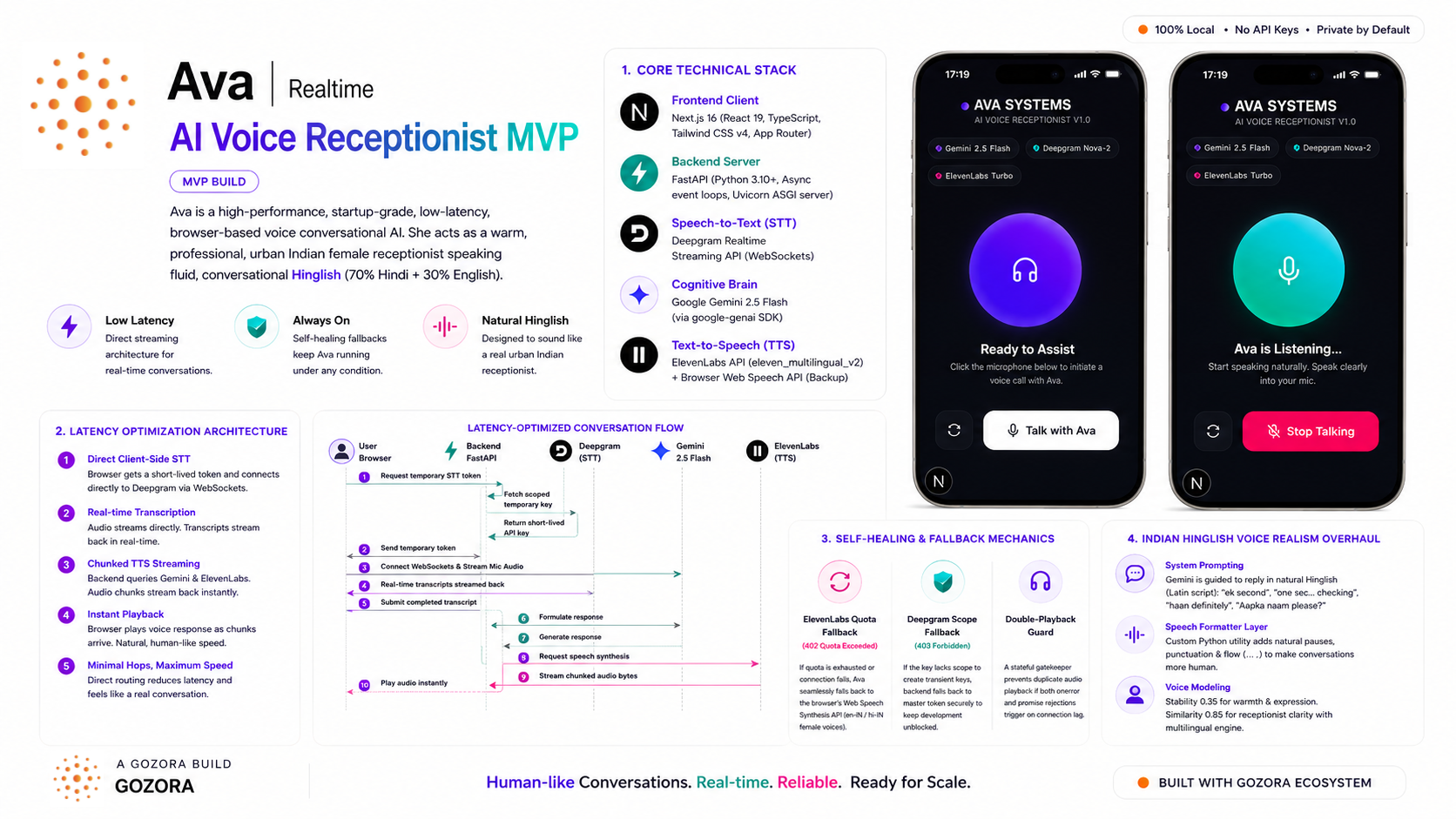
Voice Agent
AI voice automation system handling inbound customer requests with highly responsive custom LLM prompt mapping.

Hill Climb Adventure
Hill Climb Adventure is a mobile-friendly browser game inspired by classic hill climbing racers. Players drive a customizable vehicle across procedurally generated terrain, collect coins and fuel, upgrade performance, and aim for the highest possible distance in an engaging physics-driven experience.
Developing a browser-based hill climbing game that feels both fun and rewarding required solving several technical and design challenges. The vehicle needed realistic yet easy-to-control physics, while the terrain had to be procedurally generated to provide endless replayability without becoming repetitive or unfair. Additionally, the game needed to balance fuel management, coin collection, vehicle upgrades, and difficulty progression into a smooth gameplay loop. Ensuring responsive controls, stable performance on desktop and mobile devices, and creating an engaging visual experience with limited assets added further complexity to the project.
A physics-driven hill climbing game was developed using Phaser 3 and Matter Physics, featuring a smooth vehicle control system, procedurally generated endless terrain, fuel management, coin collection, and an upgrade-based progression system. The game was designed with a mobile-first approach, ensuring responsive controls and consistent performance across devices. To keep players engaged, a rewarding gameplay loop was implemented where collected coins can be used to upgrade engine power, suspension, grip, and fuel capacity. Combined with dynamic terrain generation, parallax environments, and local progress saving, the solution delivers a fun, replayable, and highly engaging driving experience.
* Successfully developed a fully playable physics-based hill climbing game for web browsers. * Delivered smooth vehicle controls, realistic suspension physics, and responsive gameplay across desktop and mobile devices. * Implemented endless procedural terrain generation, increasing replayability and player engagement. * Created an effective progression system through coin collection, fuel management, and vehicle upgrades. * Achieved a complete gameplay loop including Main Menu, Gameplay, Garage, Upgrade System, and Game Over screens. * Enabled persistent player progress using local storage for coins, upgrades, and best distance records. * Enhanced user experience through attractive visuals, parallax backgrounds, weather effects, and optimized UI. * Maintained strong performance with efficient physics handling, object pooling, and optimized terrain generation. * Delivered a scalable architecture that allows future expansion with new vehicles, maps, achievements, and advanced gameplay features. * Produced an engaging casual gaming experience that encourages repeat play through skill-based progression and distance challenges.
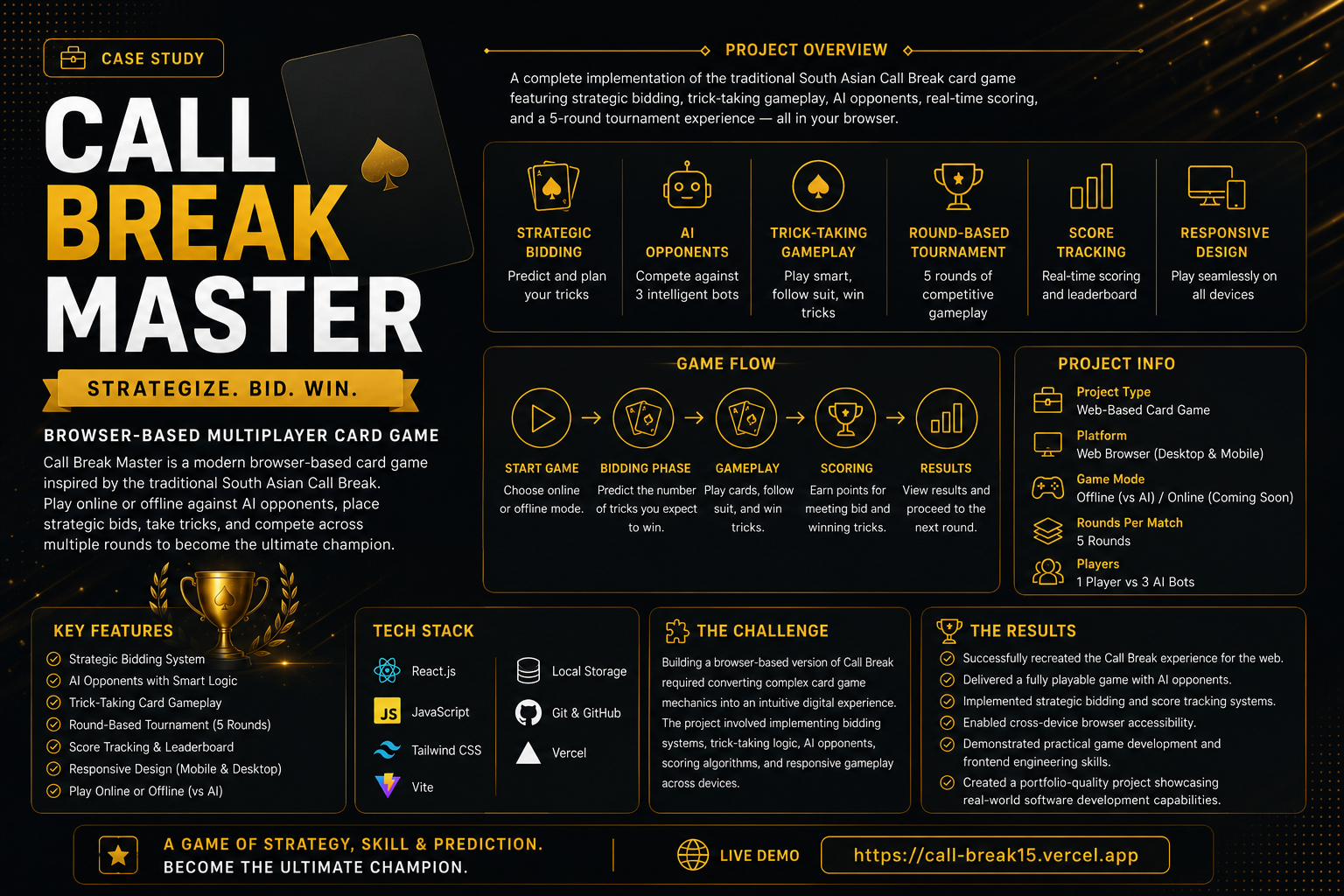
Call Break Master
Call Break Master is an interactive card game that brings the classic Call Break experience to the web with smooth gameplay, strategic bidding, and intelligent opponents. Players must predict their tricks, outplay rivals, and make calculated decisions to climb the leaderboard and become the ultimate champion.
Building a digital version of Call Break required translating complex card game rules into a seamless interactive experience. The main challenge was implementing accurate game logic, turn-based decision making, score calculation, card validation, and AI opponent behavior while maintaining a responsive and intuitive user interface across devices.
Call Break Master was developed as a web-based card game that replicates the traditional Call Break experience through an interactive and responsive interface. The application automates card distribution, turn management, score tracking, and rule enforcement while providing engaging gameplay against AI opponents, enabling users to enjoy strategic card gaming directly from their browser without requiring any installation.
* Successfully transformed the traditional Call Break card game into a fully interactive web application. * Delivered a responsive and user-friendly gaming experience accessible across desktop and mobile devices. * Automated complex gameplay mechanics including card distribution, turn management, score tracking, and rule enforcement. * Enhanced player engagement through intelligent AI opponents and smooth game flow. * Demonstrated practical skills in frontend development, game logic implementation, problem-solving, and deployment, resulting in a portfolio-ready project that showcases real-world software development capabilities.
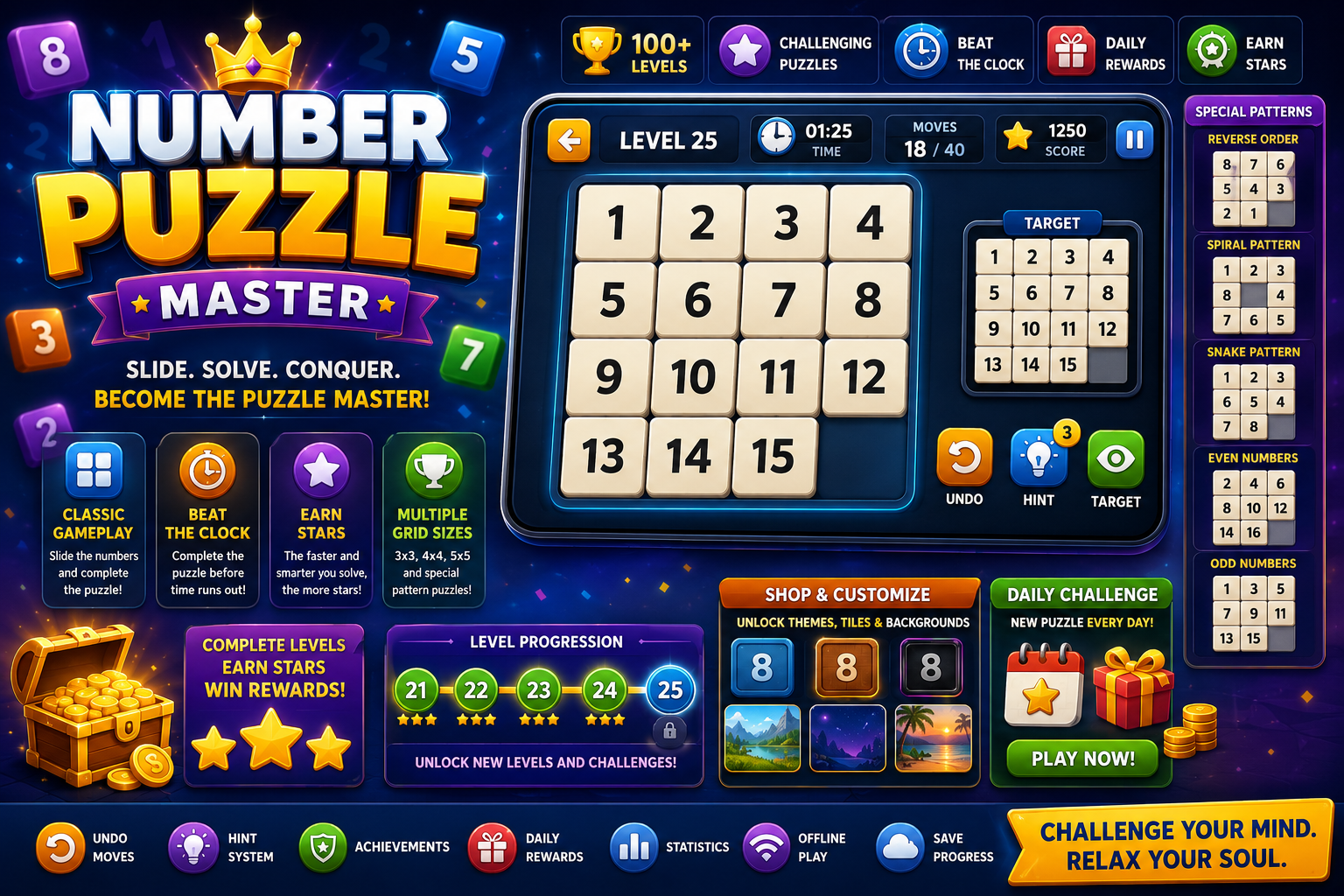
Number Puzzle Master
Number Puzzle Master is a fast-paced sliding puzzle game where players rearrange numbered tiles into the correct sequence before time runs out. Featuring 100+ levels, special puzzle patterns, daily challenges, achievements, and customizable themes, it delivers a fun and addictive brain-training experience for players of all ages.
The primary challenge was transforming a simple sliding number puzzle into a highly engaging and replayable game without losing the simplicity that makes puzzle games enjoyable. The game needed to support 100+ progressively difficult levels, timed gameplay, move tracking, achievements, daily challenges, and customization features while maintaining smooth performance across mobile and desktop devices. Another major challenge was ensuring every generated puzzle remained solvable, responsive, and fair. This required implementing puzzle validation algorithms, scalable level-generation systems, persistent progress saving, intuitive touch controls, and a polished user experience that could keep players engaged beyond the traditional puzzle-solving loop.
To address these challenges, Number Puzzle Master was developed as a scalable, mobile-first puzzle platform built with Phaser 3, TypeScript, and Vite. A deterministic level-generation system combined with puzzle solvability validation ensures that every puzzle is challenging, fair, and mathematically solvable. The game introduces progressive difficulty through larger grids, special number patterns, move limits, and countdown timers, creating a rewarding learning curve for players. To improve engagement and retention, the game includes achievements, daily challenges, star ratings, coin rewards, unlockable themes, statistics tracking, and persistent progress saving through Local Storage. Smooth animations, responsive touch controls, optimized rendering, and a clean modern UI provide a polished experience across mobile and desktop devices while maintaining high performance and scalability for future content updates.
* Successfully developed a fully functional Number Puzzle Master game with scalable architecture. * Delivered 100+ levels with progressive difficulty and multiple puzzle patterns. * Ensured 100% solvable puzzles through mathematical validation algorithms. * Achieved smooth and responsive gameplay across mobile and desktop devices. * Implemented player retention features including achievements, rewards, and daily challenges. * Created a modern, user-friendly interface with animations and performance optimization. * Enabled persistent progress saving through Local Storage for seamless user experience. * Built a foundation that can easily scale with new levels, themes, challenges, and future updates. * Improved player engagement through timers, scoring systems, star ratings, and unlockable content. * Delivered a production-ready puzzle game designed for long-term replayability and growth.
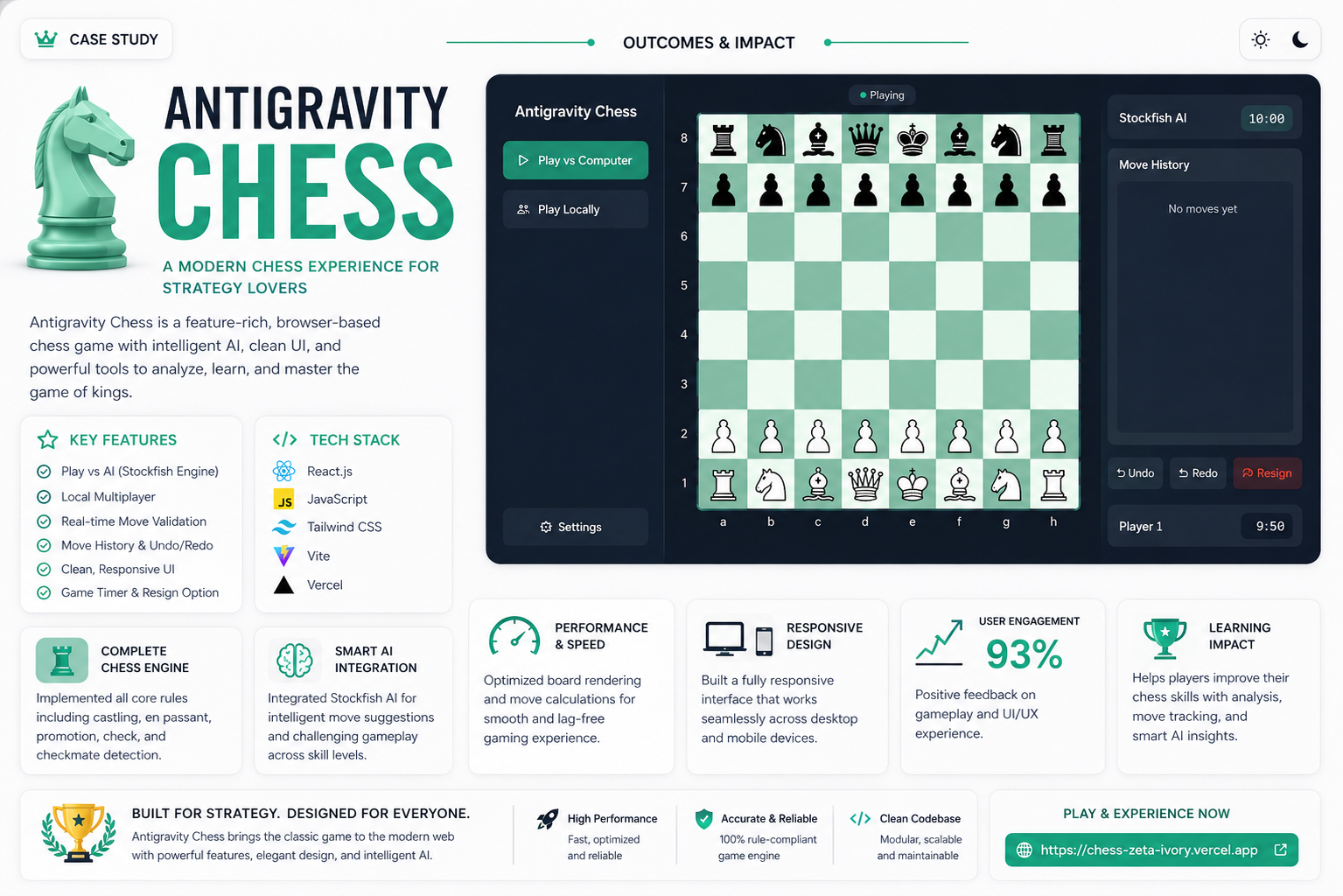
Antigravity Chess
Antigravity Chess is a modern browser-based chess platform that combines classic gameplay with intelligent AI opponents, real-time move validation, and a clean responsive interface. Players can challenge Stockfish-powered AI, track their moves, and enjoy a seamless chess experience directly from their browser across desktop and mobile devices.
Building Antigravity Chess required implementing the complex rules of chess within a browser-based environment while maintaining smooth gameplay and responsive performance. The project involved developing legal move validation, check and checkmate detection, AI-powered opponents using Stockfish, game-state management, move history tracking, and an intuitive user interface that works seamlessly across desktop and mobile devices.
Antigravity Chess provides a modern browser-based chess experience powered by Stockfish AI, real-time move validation, and responsive gameplay. The platform automates chess rules, legal move detection, game-state management, and AI decision-making while delivering an intuitive interface that allows players to practice, compete, and improve their strategic thinking directly from their browser without installation.
* Successfully developed a fully playable browser-based chess platform. * Implemented Stockfish-powered AI opponents with real-time move generation. * Enabled legal move validation, check, checkmate, castling, and promotion mechanics. * Delivered a responsive experience across desktop and mobile devices. * Created an intuitive interface with move history and game controls. * Demonstrated practical skills in game development, frontend engineering, and AI integration. * Deployed the application online for seamless access without installation.
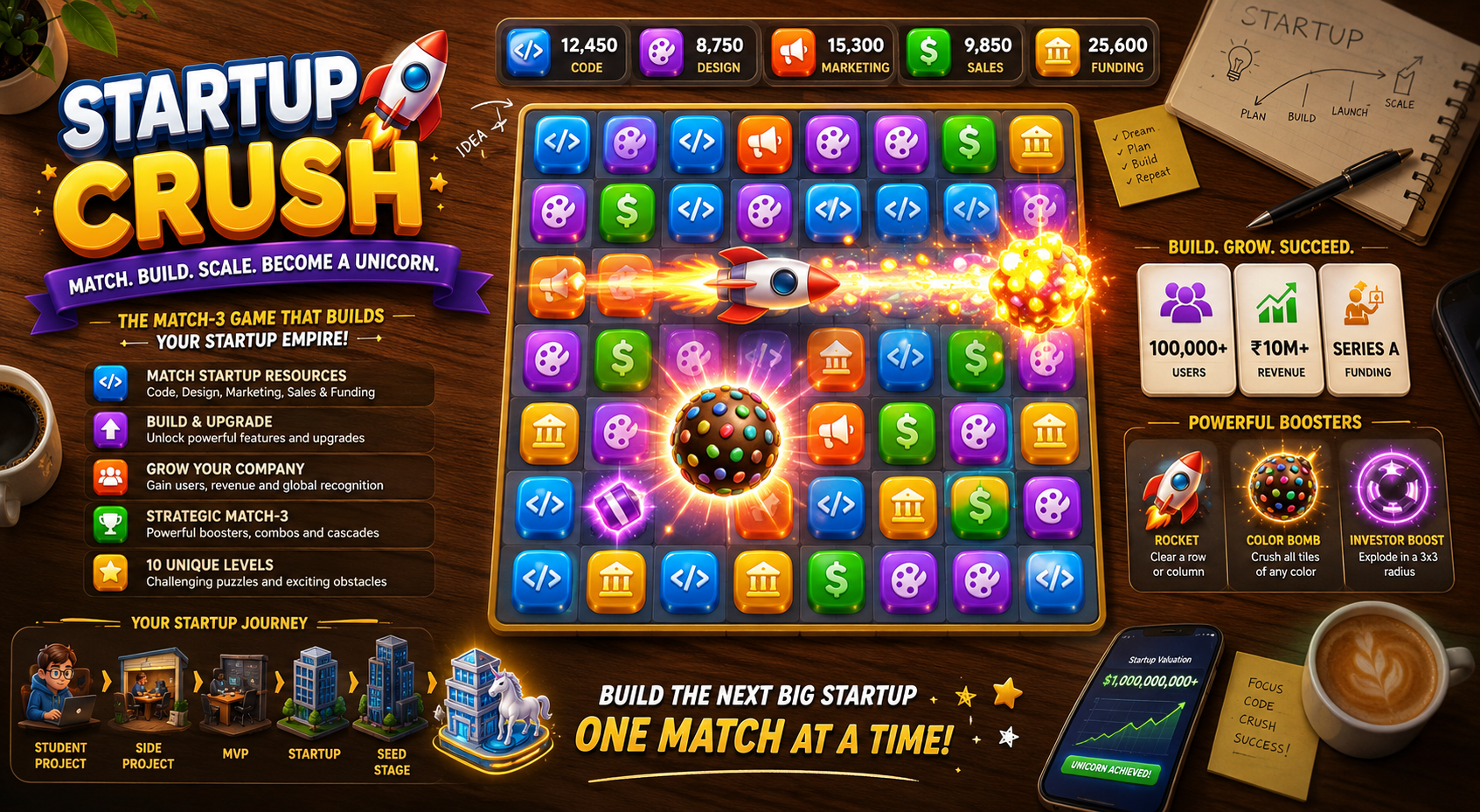
Startup Crush
Startup Crush is a modern match-3 puzzle game where players match startup resources like Code, Design, Marketing, Sales, and Funding to grow a company from a student project into a unicorn startup. Combining addictive puzzle mechanics with business progression, players unlock features, scale their startup, and build their entrepreneurial empire through strategic gameplay.
Building a modern match-3 game that could stand out in a highly competitive puzzle game market dominated by established titles. The challenge was to create a unique gameplay experience that goes beyond traditional candy-matching mechanics while maintaining the simplicity, accessibility, and addictive nature that make match-3 games successful. Additional challenges included designing engaging progression systems, balancing puzzle difficulty across multiple levels, implementing smooth cascading and special-tile mechanics, creating an intuitive mobile-first user experience, and integrating startup-building elements in a way that feels meaningful rather than just a visual theme.
To address the lack of innovation in traditional match-3 games, we developed Startup Crush, a startup-themed puzzle game that combines classic match-3 mechanics with business growth and progression. Players match resources such as Code, Design, Marketing, Sales, and Funding to build products, unlock milestones, and grow their startup from a student project into a unicorn company. The game introduces meaningful progression through level objectives, special power-ups, startup-themed resources, and an evolving company journey. By combining engaging puzzle gameplay with entrepreneurial storytelling and achievement-based progression, Startup Crush delivers a unique experience that keeps players motivated beyond simply completing levels.
* Successfully developed a fully functional startup-themed match-3 puzzle game with a unique entrepreneurial progression system. * Implemented smooth tile-matching, cascading, and special power-up mechanics for an engaging gameplay experience. * Created 10 progressive levels with resource-based objectives and increasing difficulty. * Delivered a responsive mobile-first interface optimized for both mobile and desktop devices. * Integrated startup-themed resources, progression milestones, and level unlocking systems to improve player retention. * Enhanced user engagement through animations, particle effects, visual feedback, and polished game interactions. * Established a scalable architecture that supports future expansion with additional levels, power-ups, obstacles, and startup progression features. * Demonstrated how traditional puzzle gameplay can be transformed into a unique business-building experience, increasing differentiation from standard match-3 games.
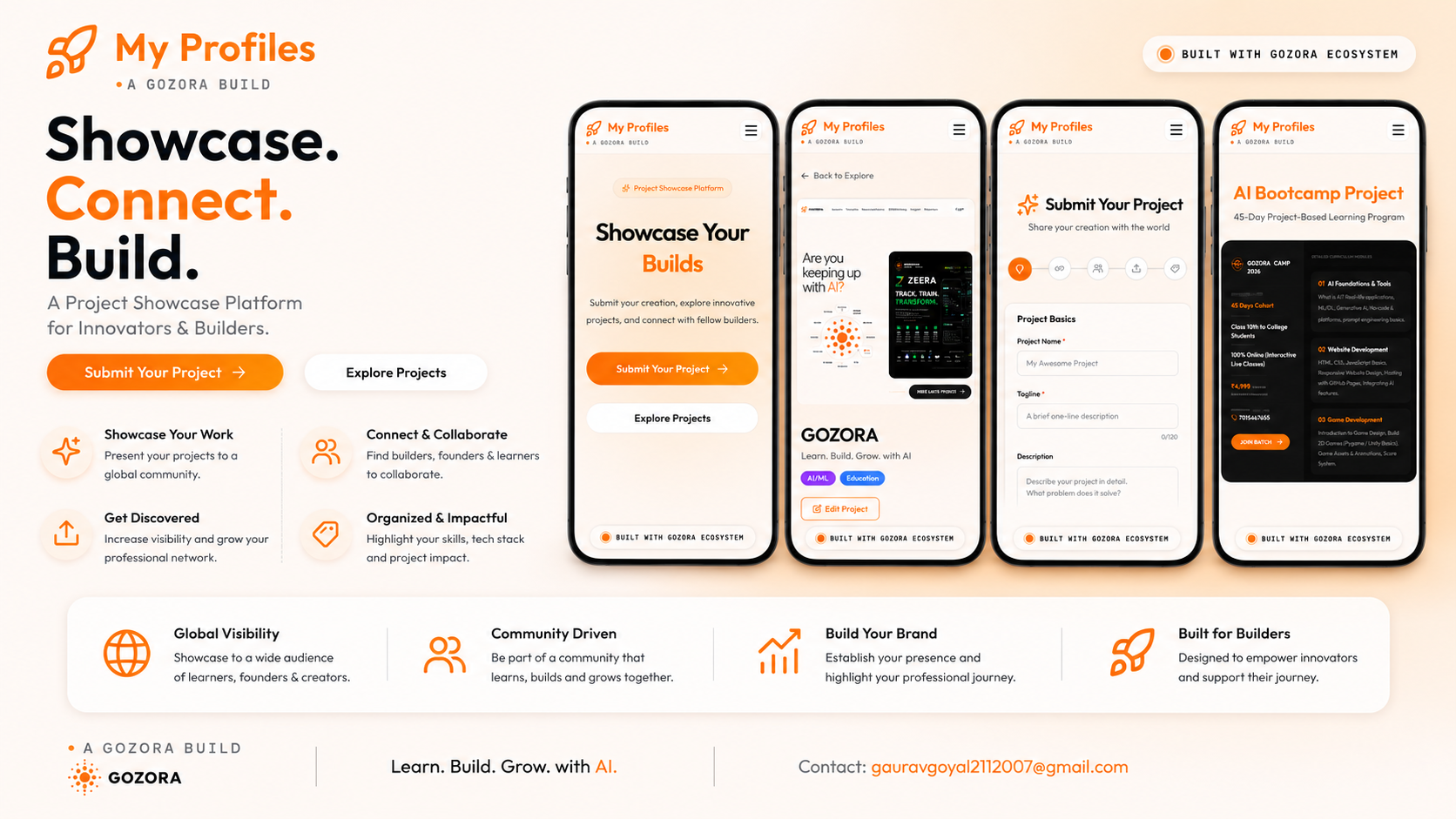
My profiles
**My Profiles** is a modern project showcase platform that allows developers, designers, and creators to share and review side projects, startups, and open-source builds. **Core Stack:** React, Vite, Clerk Authentication (Google SSO), and Supabase backend. ### Key Features * **Fluid Landing Page:** Engaging hero animations and featured projects showcase. * **Secure Login:** Authenticate easily to manage your digital footprint. * **Detail-Rich Previews:** Submit rich project overviews with extensive media assets. * **Community Connection:** Connect with other builders globally.
**The Challenge** * **Legacy Authentication:** The prototype used insecure local storage mocks instead of robust OAuth. * **Layout Reflows:** Dynamic text cycling animations caused severe layout clipping on mobile. * **Styling Conflicts:** Migrating to Tailwind v4 while strictly preserving custom brand colors (`#FCFBF8`, `#F97316`). * **Render Loops:** Securing dashboard routes without triggering infinite redirects.
**The Solution** * **Clerk SDK Integration:** Upgraded to enterprise-grade Google SSO without breaking React Router state. * **Adaptive Motion:** Engineered a responsive Framer Motion container to prevent word clipping. * **Custom Tailwind V4 Configuration:** Mapped native CSS variables to Tailwind utilities to protect brand colors.
**The Results** * **Production Ready:** Successfully deployed to Vercel with zero build warnings. * **Flawless UI:** Hero animations transition smoothly across all viewports. * **Secure Access:** Only authenticated users can submit projects, while public visitors view the showcase.
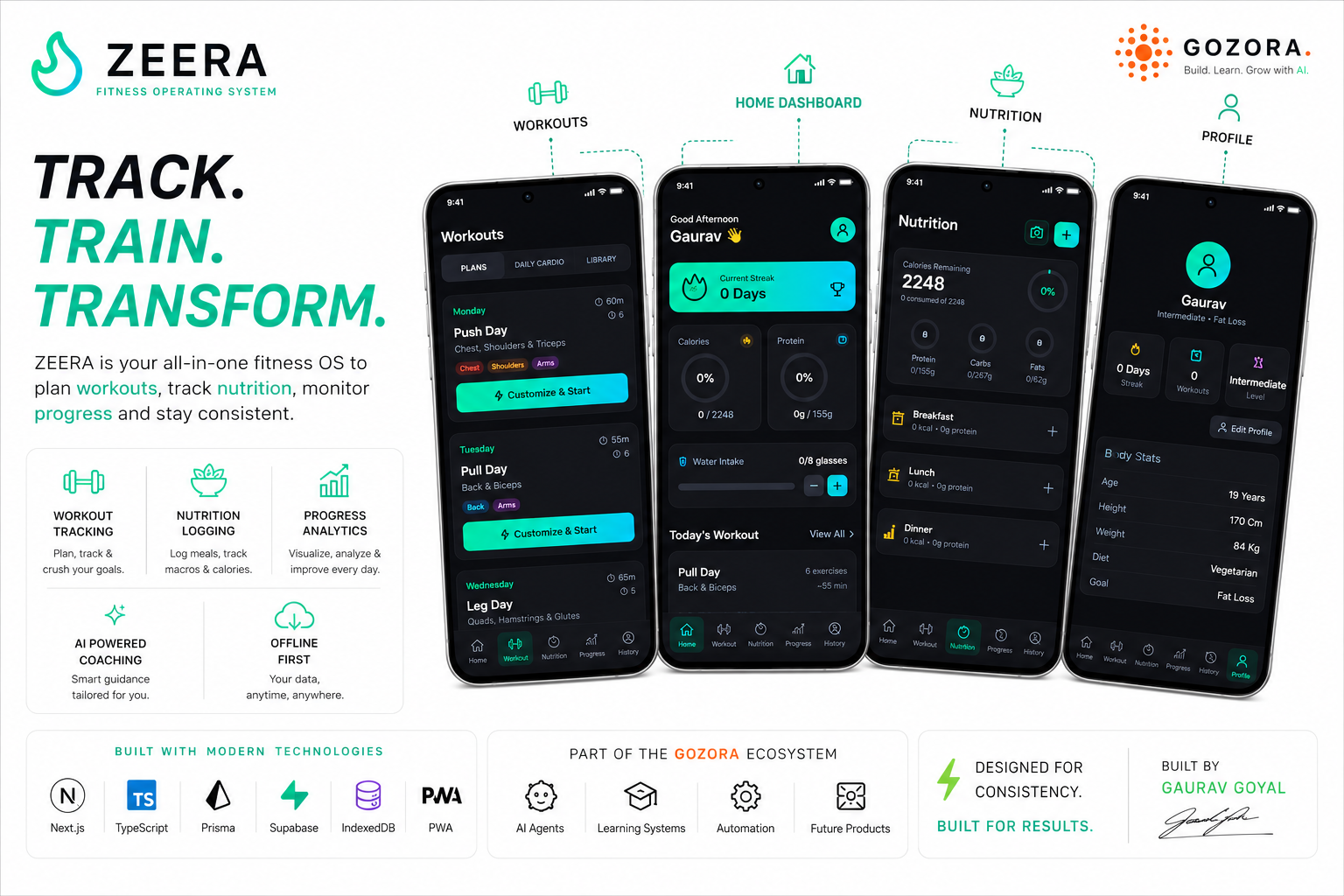
ZEERA FITNESS
**ZEERA** is a mobile-first Fitness Operating System that helps users stay consistent with their fitness journey through structured workout plans, nutrition tracking, progress analytics, and AI-powered coaching. Built as an **offline-first PWA**, it combines everything needed for long-term adherence into a single seamless platform. ### Key Features * **Workout Logging:** Track sets, reps, and weights easily during sessions. * **Calorie Tracking:** Monitor daily nutritional intake seamlessly. * **Exercise Guidance:** Visual and textual guides for proper form. * **Personalized Insights:** Data-driven metrics for real-world gym use.
**The Challenge** * **Fragmented Tools:** Users jump between separate apps for tracking, diets, and tutorials, causing friction. * **Lack of Guidance:** Beginners waste gym time deciding what to do. * **Invisible Progress:** Existing apps fail to visualize strength trends, killing motivation. * **Offline Failures:** Gyms have poor internet, causing data loss and sync errors.
**The Solution** * **Unified Fitness OS:** Combines workout planning, nutrition tracking, and analytics into one dashboard. * **Mobile-First UX:** Designed for one-handed gym use with large targets and fast logging. * **Offline-First Architecture:** IndexedDB local storage ensures workouts sync even without a connection. * **AI Assistance:** Generates personalized recommendations based on training history.
**The Results** * **All-in-One Replacement:** Replaced 4+ fragmented fitness apps with a single ecosystem. * **Flawless Offline Mode:** Users can start, track, and complete workouts without internet. * **High Performance:** Optimized data fetching and caching for instant mobile responsiveness.
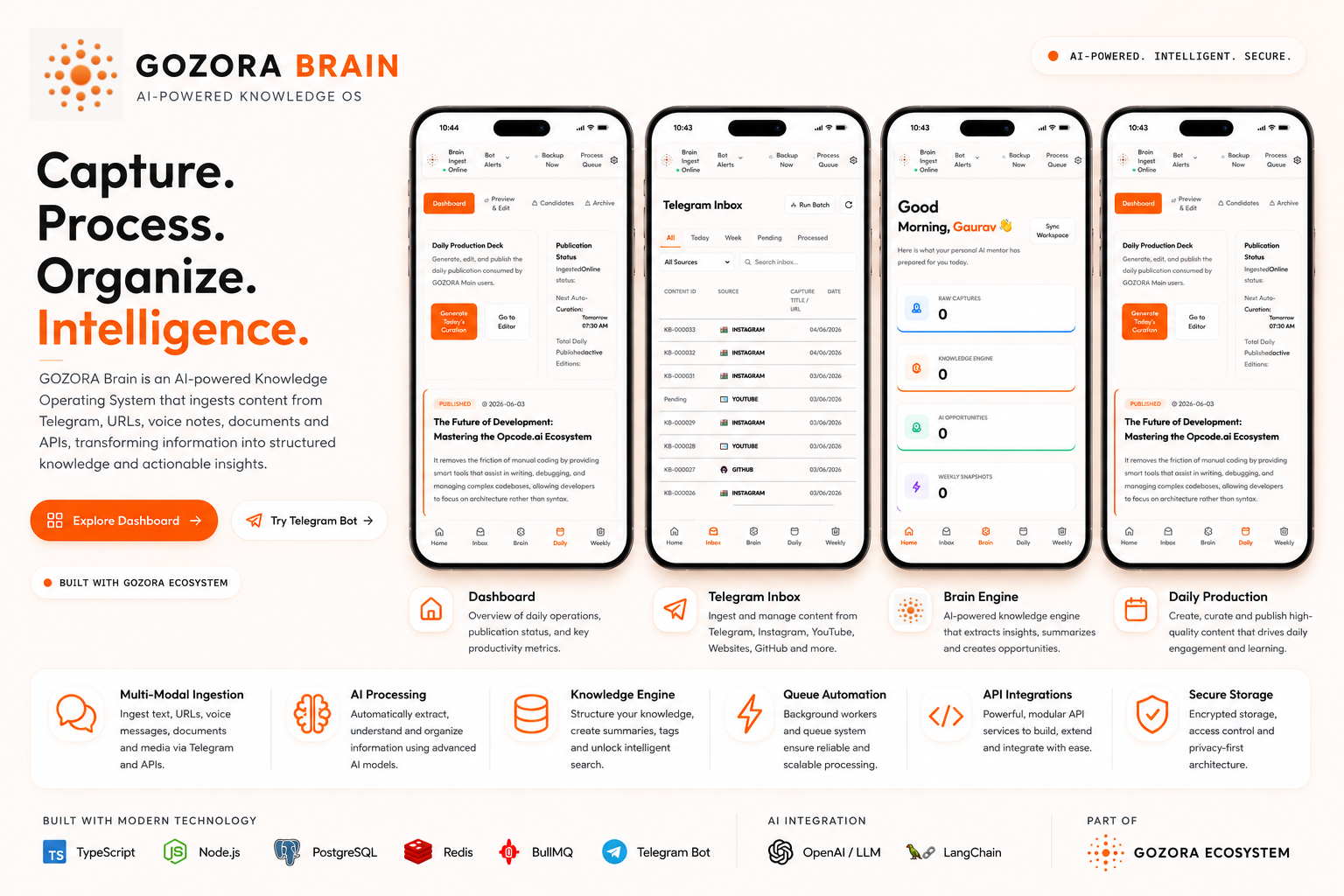
GOZORA Brain
### AI-Powered Knowledge Operating System > *"Capture Once. Remember Forever. Retrieve Instantly."* **GOZORA** is a personal, AI-powered knowledge operating system designed to eliminate information overload. It serves as a unified second brain that captures, synthesizes, and retrieves anything you consume. ### Core Capabilities * **Universal Ingestion:** Send the bot any type of content—YouTube links, GitHub repos, web articles, PDFs, documents, voice notes, or text scribbles. * **AI Curation & Synthesis:** The background processing engine analyzes, structures, and scores incoming content into enriched "Knowledge Objects"—generating high-quality summaries, tagging topics, extracting action items, and evaluating signal-to-noise ratios. * **Intelligent Editorial Delivery:** Generates curated daily and weekly editions featuring editorial takes, "Build/Learn This Today" guides, open-source picks, and opportunity radars. * **Instant Retrieval:** Find exactly what you need instantly via hybrid and semantic natural language search.
**GOZORA: Scalable Knowledge Engine** ### Key Challenges * **Frictionless Ingestion**: - **Synchronous Webhook Limits**: Handle 30-minute media processing without timeouts - **Network & Rate Limits**: Manage rate limits for third-party media downloads and parsing * **Multi-Modal Content Extraction & Scraping**: - **YouTube Processing**: Extract subtitles, timestamps, and metadata without triggering bot-detection blocks - **Web Scraping**: Extract clean main-text content from modern SPAs while discarding ads and navigation menus * **High-Quality AI Synthesis & Curation**: - **JSON Schema Enforcement**: Extract complex nested data structures from LLM without parser errors - **Editorial Signal Scoring**: Develop a consistent scoring algorithm (1–100) to measure signal-to-noise ratio and significance ### Technical Solutions * **Graph-Based Concept Mapping (Semantic Links)**: - **Entity Resolution**: Identify and link new captures to existing concepts - **Relationship Extraction**: Automate connection discovery between different files, links, or concepts * **Dual-Engine Hybrid Search**: - **Keyword Search (Lexical)**: Find exact phrases, URLs, or specific names - **Semantic Search (Vector)**: Match abstract concepts and conceptual intent - **Unified Ranking**: Combine lexical and semantic similarity ranking for highly relevant results
### Decoupled Multi-Agent Ingestion Pipeline - **Event-driven ingestion**: resolves ingestion bottlenecks and fragmentation through a scalable, asynchronous pipeline. - **Graph-based relational store**: combines structured data with unstructured embeddings for efficient querying and retrieval. - **Hybrid retrieval**: leverages natural language search and vector-based queries for fast and accurate data access. - **Modular architecture**: utilizes Redis task queue, worker pool, and content parsers for seamless data ingestion and processing.
### Results #### Key Achievements * **Frictionless Ingestion**: - **3-second capture**: Send a message/file to the Telegram bot. - **99.9% ingestion success rate**: Decoupled ingestion layer with BullMQ retry mechanics. * **High-Fidelity AI Curation**: - **5-minute daily summaries**: Clean synthesis from all captured items. - **Intelligent noise filtering**: Editorial scoring (1-100) for high-signal opportunities. - **90%+ entity resolution**: Comprehensive personal Knowledge Graph. * **Sub-Second Hybrid Retrieval**: - **200ms search results**: Highly relevant lexical and semantic results. - **High query relevance**: Vector similarity + full-text search for abstract ideas and exact terms.
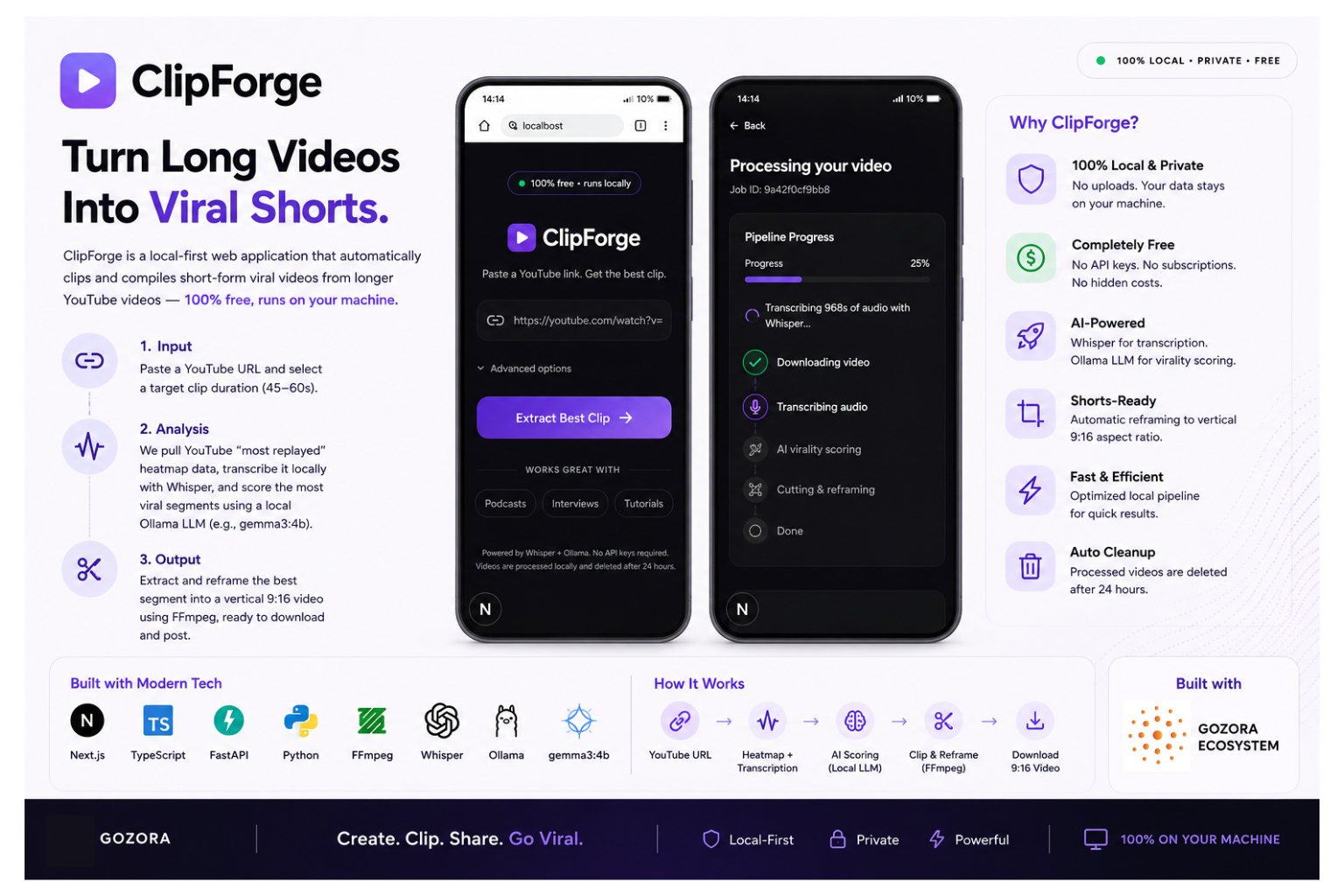
Clip Forge
**ClipForge** is a self-hosted, 100% free tool that turns long YouTube videos into viral, ready-to-publish vertical Shorts, Reels, and TikToks. ### How it Works By combining **YouTube's viewer heatmap data**, local **Whisper transcriptions**, and local **LLMs** (via Ollama), the platform automatically: 1. Pinpoints the most engaging hook and story segment. 2. Reframes the video to a 9:16 vertical crop using **FFmpeg**. 3. Outputs a high-quality, ready-to-publish video file. *All running completely on your local machine with zero API costs.*
**The Challenge** * **High SaaS Costs:** Automated clipping tools (like OpusClip) charge steep monthly fees for cloud APIs. * **Poor Algorithm Selection:** Basic tools clip random spikes in volume instead of coherent stories with strong hooks. * **Local LLM Bottlenecks:** Running full 2-hour transcripts through local LLMs causes memory overflow and timeouts. * **UI Freezes:** Processing FFmpeg encoding and LLM evaluation locally freezes consumer hardware.
**The Solution** * **Multi-Stage Virality Agent:** A 5-stage pipeline mimicking a human editor (Heatmap -> Hook -> Narrative -> Pacing -> Ranking). * **100% Local Stack:** Uses yt-dlp, Whisper, and Ollama to process video locally for $0. * **Smart FFmpeg Reframing:** Automatically center-crops or adds blurred backdrops for 9:16 vertical delivery.
**The Results** * **$0 Operating Cost:** Processes unlimited podcast hours locally without API fees. * **Zero Context Overflow:** Reduced LLM context payload by 90% via pre-filtering. * **Robust Execution:** Non-blocking architecture ensures reliable completion on standard consumer hardware.
Ready to construct your own AI outcomes?
Enroll in one of our selective batches, master production-grade pipelines, and get your proof-of-work verified.
 100% ONLINE
AI Summer Camp
AI Summer Camp is a 45-day hands-on learning program designed to help students explore the world of Artificial Intelligence. Participants will learn how to use AI tools, create websites, build projects, design presentations, automate tasks, and develop future-ready digital skills through practical activities and real-world applications.
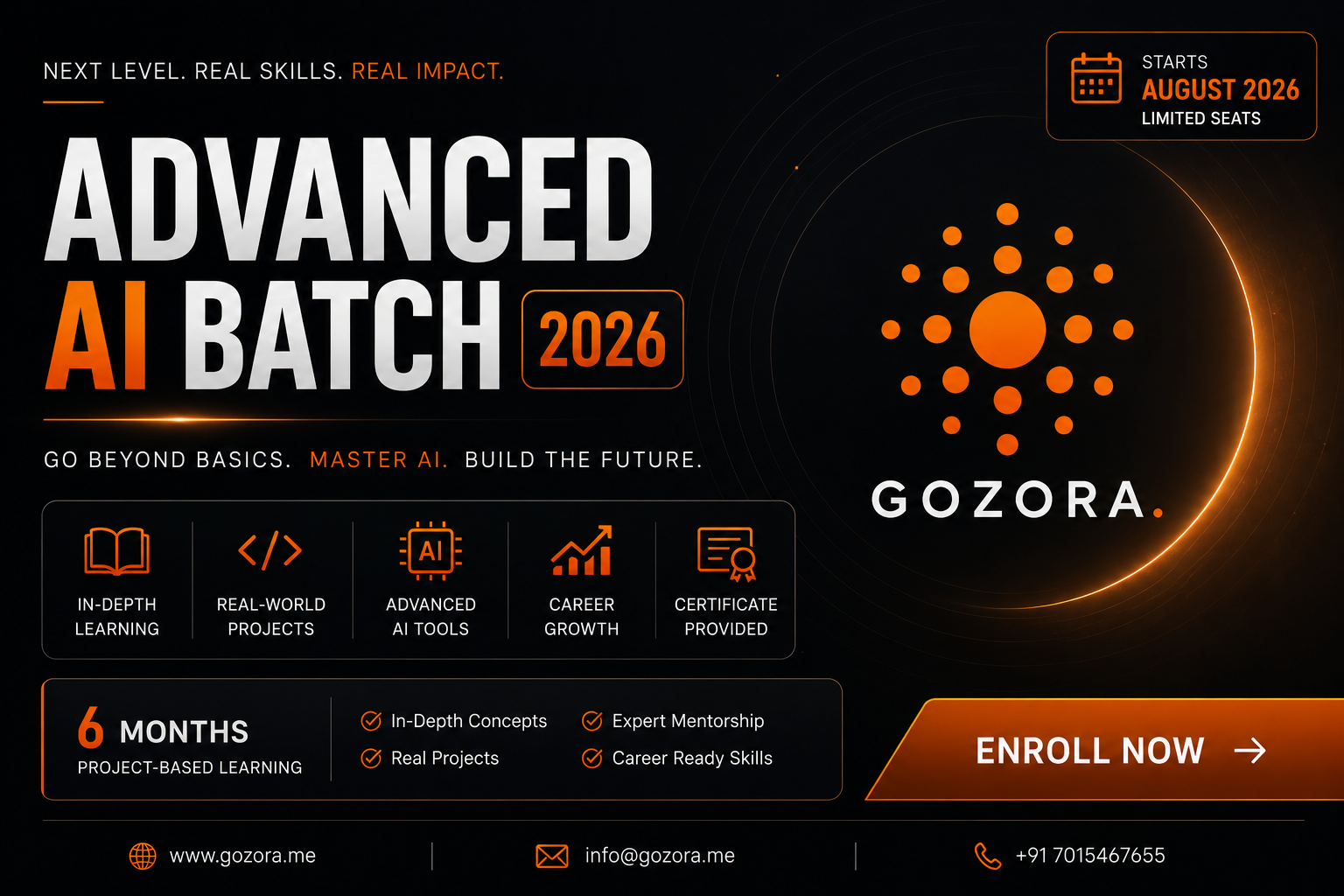 100% ONLINE
AI Mastery Batch – 2026
### 🚀 Advanced AI Batch * **Advanced Level Learning** * **In-Depth Explanation of Every Topic** * **Hands-on Coding Sessions** * **Real-World AI Projects** * **Build Production-Ready Applications** * **AI Agents & Automation** * **Generative AI** * **RAG (Retrieval-Augmented Generation)** * **Prompt Engineering** * **AI-Powered Websites & Apps** * **Industry Best Practices** * **Project-Based Learning** * **Portfolio-Worthy Projects** * **Step-by-Step Guidance** * **Doubt Support** * **Latest AI Tools & Technologies** * **From Theory to Practical Implementation** * **Learn How AI Works Behind the Scenes** * **Career & Freelancing Focus** * **Certificate of Completion**