Founder Launchcompletedby Founder of GOZORA.
GOZORA Verified Outcome
Clip Forge
ClipForge is a self-hosted, 100% free tool that turns long YouTube videos into viral, ready-to-publish vertical Shorts, Reels, and TikToks.
How it Works
By combining YouTube's viewer heatmap data, local Whisper transcriptions, and local LLMs (via Ollama), the platform automatically:
- Pinpoints the most engaging hook and story segment.
- Reframes the video to a 9:16 vertical crop using FFmpeg.
- Outputs a high-quality, ready-to-publish video file.
All running completely on your local machine with zero API costs.
System Viewport Preview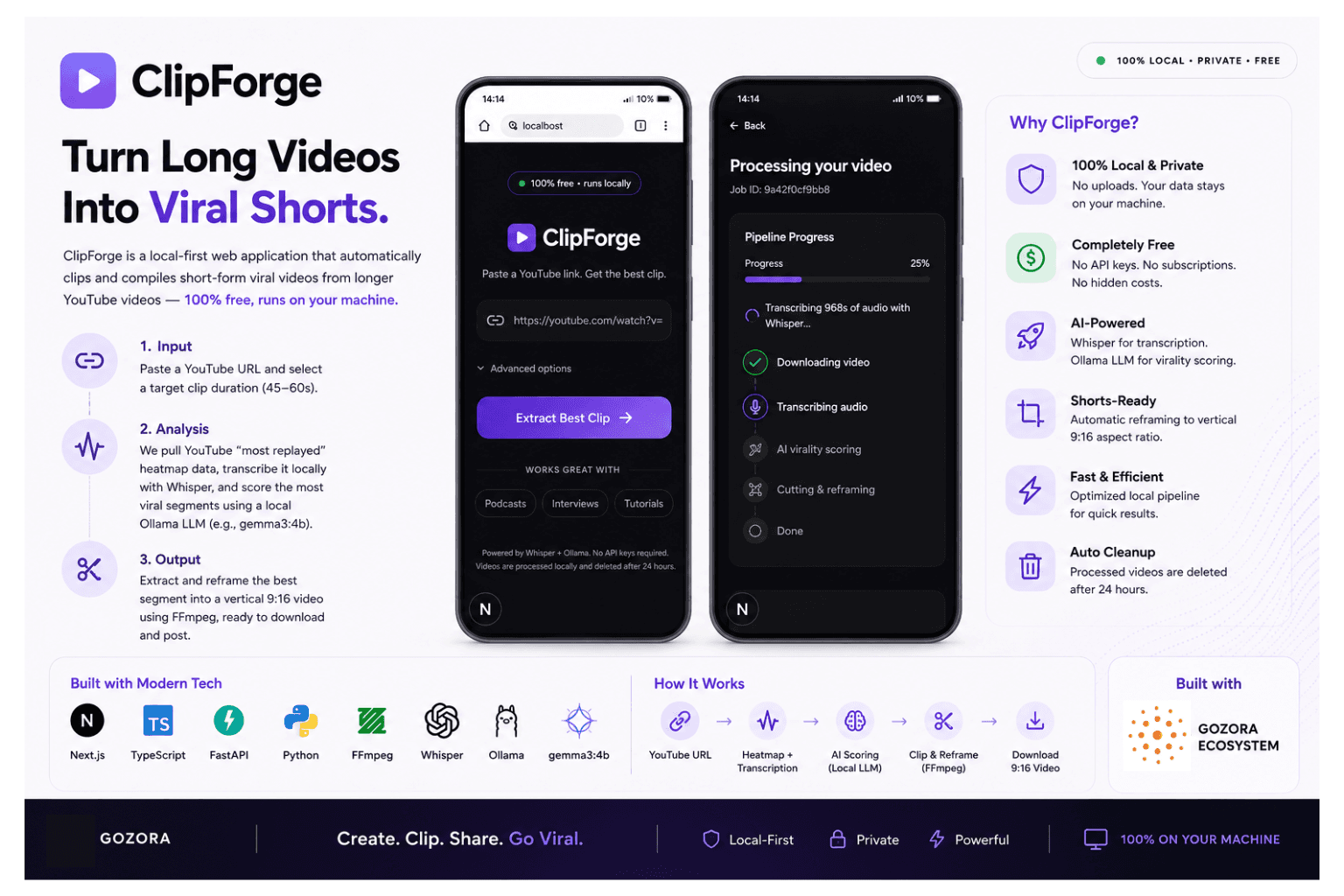
https://gozora.me/outcomes/clip-forge-fmps
The Challenge
The Challenge
- High SaaS Costs: Automated clipping tools (like OpusClip) charge steep monthly fees for cloud APIs.
- Poor Algorithm Selection: Basic tools clip random spikes in volume instead of coherent stories with strong hooks.
- Local LLM Bottlenecks: Running full 2-hour transcripts through local LLMs causes memory overflow and timeouts.
- UI Freezes: Processing FFmpeg encoding and LLM evaluation locally freezes consumer hardware.
The Solution
The Solution
- Multi-Stage Virality Agent: A 5-stage pipeline mimicking a human editor (Heatmap -> Hook -> Narrative -> Pacing -> Ranking).
- 100% Local Stack: Uses yt-dlp, Whisper, and Ollama to process video locally for $0.
- Smart FFmpeg Reframing: Automatically center-crops or adds blurred backdrops for 9:16 vertical delivery.
The Implementation
The Implementation
- Infrastructure: Segmented Next.js frontend (port 3001) from FastAPI backend (port 8000) using a local SQLite DB.
- Sliding Window Search: Bypassed LLM context limits by mathematically pre-filtering transcripts using YouTube heatmaps.
- Agent Pipeline: Optimized Ollama prompts (
gemma3:4b) to return strict JSON hook scores and narrative checks. - Concurrency: Implemented background worker threads with adaptive timeouts to prevent UI freezes.