The Implementation Process
Planning & Research Phase
The development of ZEERA began with identifying the key reasons why users fail to maintain consistency in their fitness journey. Through personal experience, competitor analysis, and fitness workflow research, several recurring challenges were identified, including fragmented fitness tools, workout uncertainty, poor progress visibility, nutrition tracking friction, and lack of personalized guidance.
A detailed product vision was established with a clear objective:
Build a single platform capable of managing the entire fitness journey while minimizing user effort and maximizing consistency.
The project scope was carefully defined before development began, ensuring that all major fitness functions could coexist within a unified ecosystem.
Product Architecture Design
Before writing code, a complete system architecture was designed to ensure long-term scalability.
The architecture focused on:
- Mobile-first user experience
- Offline-first functionality
- Modular feature-based structure
- Scalable database design
- AI integration readiness
- Future product expansion
The application was organized into dedicated modules such as:
- Authentication
- Workouts
- Nutrition
- Progress Tracking
- AI Coaching
- Recovery Systems
- Analytics
- User Profiles
This modular approach ensured maintainability and future extensibility.
User Experience & Interface Design
The entire interface was designed specifically for users interacting with the application inside a gym environment.
Key design considerations included:
- One-handed usability
- Large touch targets
- Dark mode optimization
- Minimal typing requirements
- Fast workout logging
- Quick navigation flows
- Reduced cognitive load
A mobile-first design system was created featuring:
- Consistent spacing
- Reusable components
- Responsive layouts
- Smooth animations
- Modern visual hierarchy
The goal was to create an experience that felt closer to a native mobile application than a traditional website.
Frontend Development
The frontend was built using modern web technologies to ensure performance, maintainability, and scalability.
Core Technologies
- Next.js App Router
- TypeScript
- Tailwind CSS
- Framer Motion
- Zustand
- TanStack Query
Development focused on creating reusable UI components and modular feature structures that could support rapid iteration without introducing technical debt.
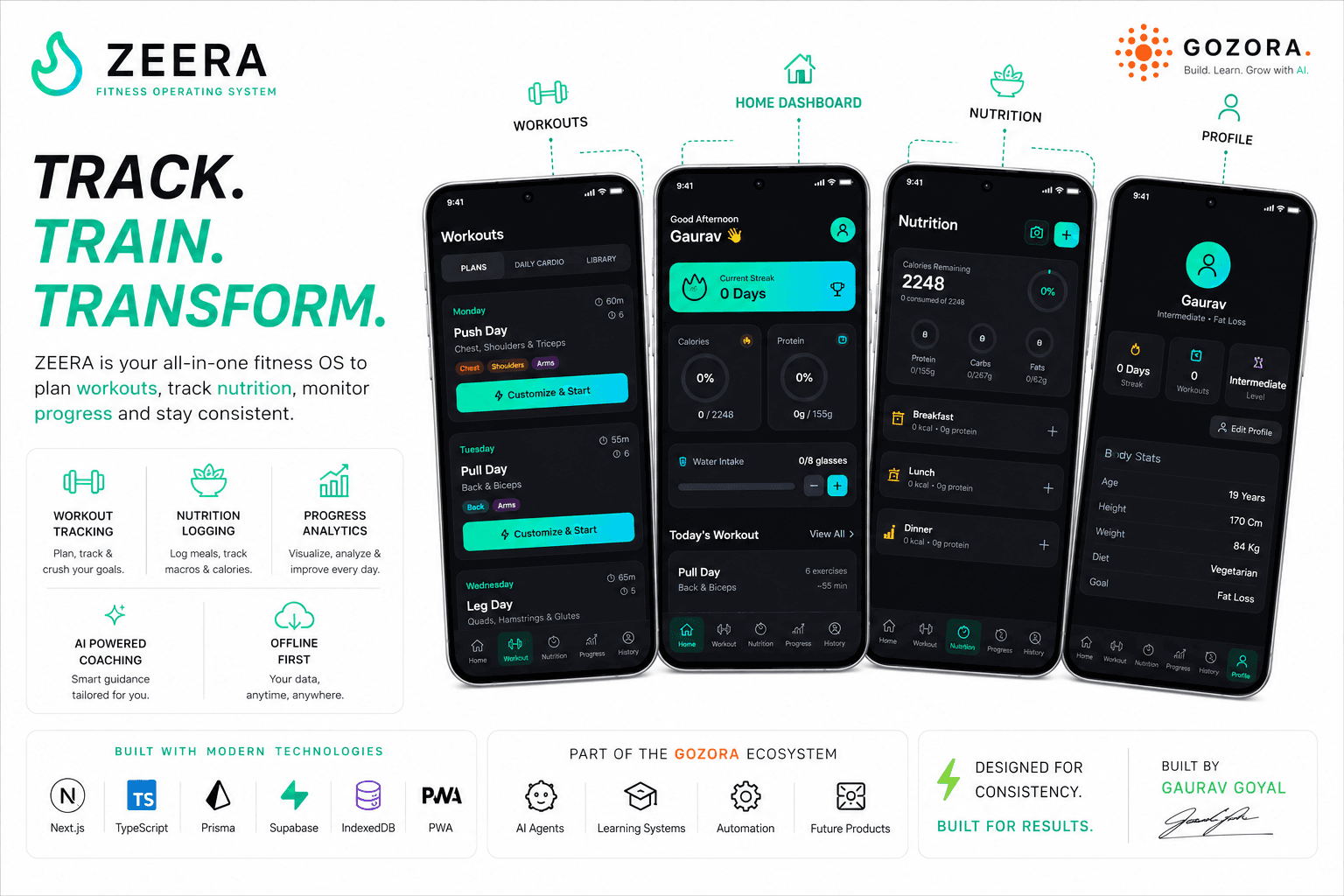
Major screens developed included:
- Home Dashboard
- Workout Management
- Active Workout Session
- Nutrition Tracking
- Progress Analytics
- User Profile
- Exercise Library
Backend & Database Development
A robust backend architecture was implemented to support structured fitness data management.
Backend Stack
- PostgreSQL
- Prisma ORM
- Supabase
- Server Actions
- API Route Handlers
The database schema was designed to support:
- User profiles
- Workout plans
- Exercise libraries
- Workout logs
- Nutrition records
- Progress tracking
- AI insights
- Recovery metrics
Special attention was given to data normalization and relationship management to ensure long-term scalability.
Offline-First Infrastructure
One of the most critical implementation phases involved building an offline-first architecture.
Many gyms suffer from poor internet connectivity, making reliability a core requirement.
To solve this challenge, ZEERA implemented:
- IndexedDB persistence
- Local data storage
- Automatic synchronization queues
- Background syncing
- Optimistic updates
- Workout recovery mechanisms
This ensures users can continue logging workouts even when completely offline.
Once connectivity is restored, all pending actions are synchronized automatically with the cloud database.
Workout Engine Development
The workout engine serves as the foundation of ZEERA.
Implementation included:
- Workout plan management
- Set tracking
- Rep tracking
- Weight logging
- Rest timers
- Personal record tracking
- Previous performance comparison
- Active workout sessions
Advanced tracking capabilities were also introduced, including:
- RPE tracking
- Warm-up sets
- Drop sets
- Tempo tracking
- Progressive overload support
The workout experience was optimized for speed, requiring as few interactions as possible during training sessions.
Exercise Library Integration
A scalable exercise management system was developed to provide users with educational and instructional content.
An automated exercise ingestion pipeline was created to:
- Import exercise data
- Normalize metadata
- Generate exercise slugs
- Categorize movements
- Store exercise media
- Support future content expansion
The exercise system includes:
- Exercise demonstrations
- Muscle targeting information
- Equipment requirements
- Form instructions
- Safety guidance
This transformed ZEERA from a tracking application into a learning platform as well.
Nutrition System Development
A nutrition tracking engine was implemented to simplify dietary adherence.
Development focused on reducing logging friction through:
- Fast food search
- Quick-add actions
- Favorite meals
- Recent foods
- Meal categorization
- Macro tracking
- Calorie monitoring
Special consideration was given to supporting commonly consumed Indian foods alongside standard international food options.
Analytics & Progress Tracking
A dedicated analytics layer was built to help users visualize their fitness journey.
The implementation included:
- Weight tracking
- Strength progression monitoring
- Workout consistency metrics
- Progress charts
- Historical data analysis
- Trend visualization
The objective was to convert raw fitness data into meaningful and actionable insights.
AI Readiness & Intelligence Layer
The platform was designed with future AI integration in mind.
To support intelligent coaching systems, the architecture was prepared to collect and organize contextual fitness data, including:
- Workout history
- Nutrition adherence
- Progress trends
- Recovery metrics
- User goals
This foundation enables future implementation of personalized coaching, recommendation systems, and retrieval-augmented AI workflows.
Performance Optimization
Throughout development, significant attention was given to performance optimization.
Key optimizations included:
- Lazy loading
- Route-based code splitting
- Query caching
- Optimized media handling
- Efficient state management
- Mobile-first rendering strategies
These optimizations ensure the application remains responsive even during long workout sessions.
Testing & Refinement
The application underwent continuous testing and refinement throughout development.
Testing focused on:
- Mobile responsiveness
- Workout session stability
- Offline recovery
- Data synchronization
- Navigation flows
- Performance benchmarks
- User interaction efficiency
Multiple iterations were performed to improve usability, reduce friction, and optimize the overall experience.
Final Outcome
The implementation process resulted in a production-grade, mobile-first Fitness Operating System capable of supporting the complete fitness lifecycle.
By combining modern web technologies, scalable architecture, offline-first infrastructure, and user-centered design principles, ZEERA successfully transformed from an initial concept into a fully functional platform designed to help users train smarter, track progress effectively, and remain consistent over the long term.